

As a supplier of cat skeletons, I've had the privilege of closely examining and understanding the intricate details of feline skeletal structures. Through my work, I've also delved into the skeletons of other animals, including dogs. In this blog, I'll explore the key differences between a cat skeleton and a dog skeleton, offering insights that can be valuable for various fields, from veterinary science to education.
Overall Size and Proportion
One of the most noticeable differences between cat and dog skeletons lies in their overall size and proportion. Generally, dogs are larger than cats, which is reflected in the dimensions of their skeletons. Dog skeletons tend to be more massive, with longer limbs and a larger torso. For example, a large - breed dog like a Great Dane can have a skeleton that is several times larger than that of a domestic cat.
Cats, on the other hand, have a more compact and agile skeletal structure. Their bones are lighter and more slender, which allows them to be incredibly nimble. This compactness is an adaptation for activities such as climbing, hunting, and squeezing through small spaces. In contrast, dogs' larger and more robust skeletons are better suited for activities like running long distances, pulling, and carrying heavier loads.
Skull Structure
The skulls of cats and dogs also exhibit significant differences. Cat skulls are relatively short and rounded, with a more pronounced domed shape. This shape is well - adapted for their hunting behavior. Cats have powerful jaw muscles that are attached to a relatively short skull, which gives them a strong bite force. Their teeth are also specialized for hunting and killing prey. They have sharp canines for puncturing and holding, and carnassial teeth for shearing meat.
Dog skulls come in a wider variety of shapes, depending on the breed. Some breeds, like the Greyhound, have long, narrow skulls, which are associated with their speed and streamlined appearance. Other breeds, such as the Bulldog, have short, broad skulls. In general, dog teeth are also adapted for a carnivorous diet, but their dentition may vary more widely between breeds compared to cats. For example, some dog breeds have more pronounced molars, which may be used for chewing a wider variety of foods.
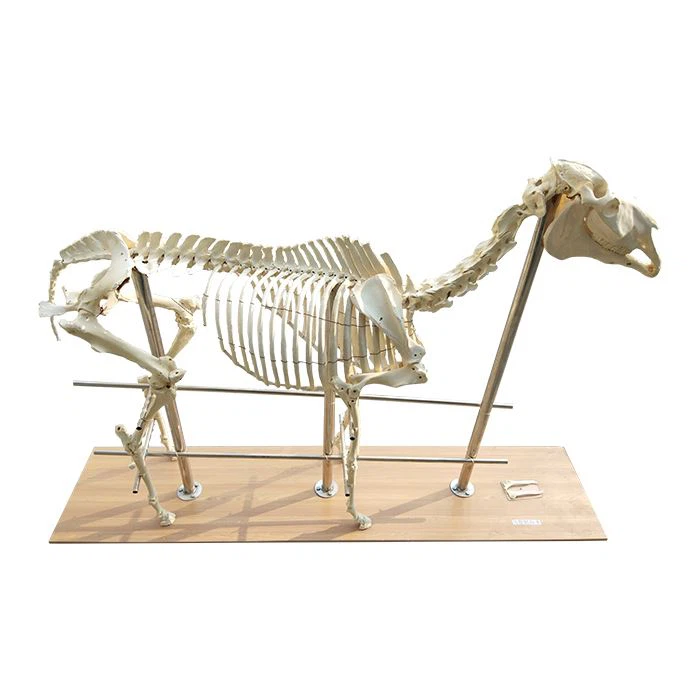

Vertebral Column
The vertebral column, or spine, is another area where cat and dog skeletons differ. Cats have a highly flexible spine, with more vertebrae in their neck (seven, like most mammals) and a greater range of motion in their thoracic and lumbar regions. This flexibility allows them to arch their backs, twist, and turn with ease. It is also essential for their hunting and climbing abilities, as they can quickly change direction and position while in pursuit of prey or navigating through trees.
Dogs also have a flexible spine, but their range of motion may be more limited compared to cats. However, their spines are well - adapted for different types of locomotion. For example, running dogs, such as Greyhounds, have a long and flexible spine that helps them generate a powerful stride. Working dogs, like German Shepherds, have a strong and stable spine to support their activities, such as herding and carrying loads.
Limb Bones
The limb bones of cats and dogs show distinct characteristics. In the forelimbs, cats have relatively short and muscular humerus bones, which are well - suited for climbing and grasping. Their radius and ulna bones are also more mobile, allowing for greater rotation of the paw. This mobility is useful for tasks such as catching and holding prey.
Dogs' forelimb bones are often longer and more robust. Their humerus is designed to support their body weight during locomotion, especially in larger breeds. The radius and ulna in dogs are more firmly connected, which provides stability during running and other activities.
In the hindlimbs, cats have powerful femur bones that give them the ability to jump great heights and distances. Their tibia and fibula are also well - developed, contributing to their explosive jumping and running abilities. Dogs' hindlimbs are also strong, but their structure may vary depending on the breed. For example, breeds that are bred for speed, like the Whippet, have long and slender hindlimb bones, which help them achieve high velocities.
Pelvis and Hip Joint
The pelvis and hip joint are important for locomotion and stability. Cat pelves are relatively narrow, which is consistent with their small and agile body structure. Their hip joints are designed for a wide range of motion, allowing them to make quick turns and sudden stops. This is crucial for their hunting and evasive maneuvers.
Dog pelves come in different shapes and sizes depending on the breed. Larger breeds typically have broader pelves to support their larger body mass. Their hip joints are also well - adapted for different types of movement. For example, herding dogs need a stable hip joint to perform quick and precise movements while controlling livestock.
Rib Cage
The rib cage of a cat is more oval - shaped and relatively flexible. This flexibility allows the cat to expand its chest cavity when taking in air, which is important for its high - energy activities such as running and climbing. The ribs of a cat are also more slender compared to those of a dog.
Dog rib cages are generally more rectangular in shape and more rigid. This rigidity provides support for the internal organs and is well - suited for activities that require stability, such as pulling and carrying. Different dog breeds may have variations in the shape and size of their rib cages based on their specific functions and body types.
Applications and Significance of Understanding the Differences
Understanding the differences between cat and dog skeletons has several practical applications. In veterinary medicine, knowledge of these differences is essential for accurate diagnosis and treatment of skeletal disorders. For example, a veterinarian needs to understand the unique anatomy of a cat's spine when treating a spinal injury, as the treatment approach may differ from that of a dog.
In the field of education, cat and dog skeletons are often used as teaching tools to illustrate anatomical concepts. By comparing the two skeletons, students can gain a better understanding of how an animal's structure is related to its function.
In the world of art and sculpture, knowledge of these skeletal differences can help artists create more realistic and accurate depictions of cats and dogs.
Our Cat Skeleton Offerings
As a cat skeleton supplier, I take pride in providing high - quality cat skeletons for various purposes. Our skeletons are carefully prepared and preserved to ensure their authenticity and durability. Whether you are a veterinary student, an educator, an artist, or someone with a scientific interest, our cat skeletons can be a valuable addition to your collection.
If you are also interested in other animal skeletons, we offer a wide range of options. You can explore our Horse Skeleton, Cow Bones, and our general Animal Skeleton collection.
Contact for Purchase
If you are interested in purchasing cat skeletons or have any questions about our products, please feel free to reach out. We are more than happy to discuss your specific needs and provide you with detailed information about our offerings.
References
- Hyman, Libbie Henrietta. "The Invertebrates: Protozoa through Ctenophora." McGraw - Hill, 1940.
- Romer, Alfred Sherwood, and Thomas S. Parsons. "The Vertebrate Body." Saunders College Publishing, 1986.
- Dyce, K. M., Sack, W. O., and Wensing, C. J. G. "Textbook of Veterinary Anatomy." W.B. Saunders, 2002.


