

In the realm of medical education and training, the use of anatomical models has long been recognized as a valuable tool. Among these, urinary models stand out as a particularly effective resource for learning about the urinary system. As a supplier of high - quality urinary models, I have witnessed firsthand the numerous advantages that these models offer over traditional textbooks. In this blog, I will delve into the key benefits of using urinary models in educational and training settings.
Visualization and Spatial Understanding
One of the most significant advantages of using urinary models is the ability to provide a three - dimensional (3D) visualization of the urinary system. Textbooks, despite their detailed illustrations, are limited to two - dimensional representations. This can make it challenging for learners to fully grasp the complex spatial relationships between different organs and structures within the urinary system.
For example, the kidneys are complex organs with a unique shape and position within the body. In a textbook, a cross - sectional diagram may show the internal structure of the kidney, but it fails to convey the actual size, shape, and orientation of the organ in relation to other structures. A urinary model, on the other hand, allows learners to hold the kidney model in their hands, rotate it, and examine it from all angles. This hands - on experience provides a much more intuitive understanding of the kidney's spatial relationships with the surrounding organs such as the adrenal glands, ureters, and blood vessels.
The Human Reproductive System Model we offer is an excellent example. It not only shows the urinary organs but also their connection with the reproductive system. This integrated view helps students understand how these two systems interact in the human body, something that is often difficult to visualize from a textbook page.
Tactile Learning Experience
Urinary models provide a tactile learning experience that textbooks simply cannot match. When learners handle a model, they can feel the texture, shape, and consistency of the organs. This tactile feedback enhances the learning process by engaging multiple senses.
For instance, the bladder is a muscular organ that can expand and contract. By manipulating a Bladder Anatomy Model, learners can get a sense of the bladder's elasticity and how it changes shape as it fills with urine. This hands - on experience is far more memorable than reading about the bladder's function in a textbook.
Research has shown that tactile learning can improve information retention. When learners use their sense of touch in addition to sight and hearing, they are more likely to remember the information they have learned. This is because the brain processes tactile information in a different way than visual or auditory information, creating multiple neural pathways for the same knowledge.
Interactive Learning and Engagement
Urinary models encourage interactive learning, which is more engaging than passive reading from a textbook. In a classroom or training setting, models can be used for group discussions, demonstrations, and hands - on activities.
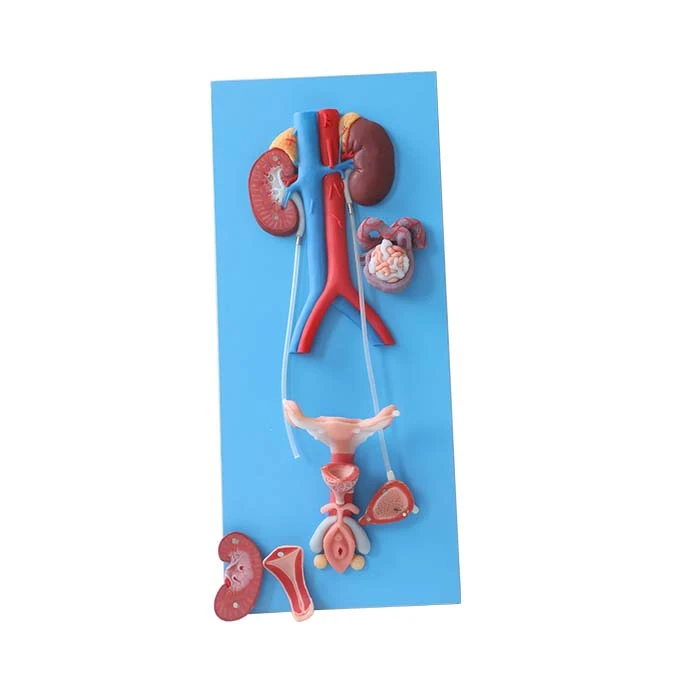

For example, instructors can use urinary models to simulate medical procedures such as catheterization. Students can practice inserting a catheter into the bladder model, which gives them a practical understanding of the procedure's steps and challenges. This type of interactive learning not only makes the learning process more enjoyable but also helps students develop the skills they need for real - world medical practice.
In contrast, textbooks are often a one - way communication tool. Students read the information, but they have limited opportunities to actively engage with the material. With urinary models, learners can ask questions, make observations, and explore the models on their own terms, leading to a more in - depth understanding of the subject matter.
Real - World Representation
Urinary models are designed to closely resemble the real human urinary system. They are made from high - quality materials that mimic the look and feel of actual organs. This real - world representation is crucial for medical students and professionals who need to be familiar with the appearance and characteristics of the urinary organs in a clinical setting.
The Female Genital Anatomy Model we supply accurately depicts the female urinary and reproductive organs. It shows the correct proportions, colors, and textures of the organs, allowing learners to gain a realistic understanding of the female urogenital system. This is especially important for medical professionals who will be performing physical examinations or surgical procedures on female patients.
Textbooks, while they may provide detailed descriptions, often cannot capture the full complexity and variability of the human body. Urinary models bridge this gap by providing a tangible representation that closely resembles what students will encounter in a real - world medical environment.
Customization and Demonstration
Another advantage of using urinary models is the ability to customize the learning experience. Instructors can use models to demonstrate specific concepts or conditions. For example, a model can be modified to show the effects of a urinary tract infection, such as inflammation of the bladder or urethra.
This customization allows for a more targeted and effective learning experience. Instructors can focus on the areas that are most relevant to the curriculum or the students' needs. Textbooks, on the other hand, are static and may not be able to provide such customized demonstrations.
Moreover, models can be used to demonstrate rare or complex conditions that may not be well - represented in textbooks. This helps learners gain a broader understanding of the urinary system and prepares them for a wider range of clinical scenarios.
Long - Term Learning and Reference
Urinary models are a long - term learning resource. Once purchased, they can be used repeatedly for multiple courses and training sessions. Unlike textbooks, which may become outdated as new research and discoveries are made, models can be updated or replaced as needed.
In addition, models can serve as a reference tool for students and professionals. They can be kept in a study area or a medical facility for quick reference when needed. This easy access to a physical representation of the urinary system can be invaluable, especially in a clinical setting where quick and accurate decision - making is essential.
Conclusion
In conclusion, the advantages of using urinary models over textbooks are numerous. They offer a better visualization of the urinary system, a tactile learning experience, interactive learning opportunities, a real - world representation, customization options, and long - term learning value.
If you are an educational institution, a medical training center, or a healthcare professional looking to enhance your learning or training programs, I encourage you to consider incorporating our high - quality urinary models. Our models are designed to meet the highest standards of accuracy and durability, providing an excellent learning resource for students and professionals alike.
To learn more about our urinary models and to discuss your specific needs, please feel free to contact us. We are committed to providing the best products and services to support your educational and training goals.
References
- Kolb, D. A. (1984). Experiential learning: Experience as the source of learning and development. Prentice - Hall.
- National Research Council. (2000). How people learn: Brain, mind, experience, and school. National Academies Press.


