

Donkeys have been the unsung heroes of the animal - kingdom for centuries, especially when it comes to carrying loads. As an animal skeleton supplier, I've had the privilege of closely examining donkey skeletons and understanding the remarkable adaptations that allow these creatures to perform such a demanding task. In this blog, I'll break down how the donkey's skeleton supports its load - carrying ability.
Overall Structure and Adaptations
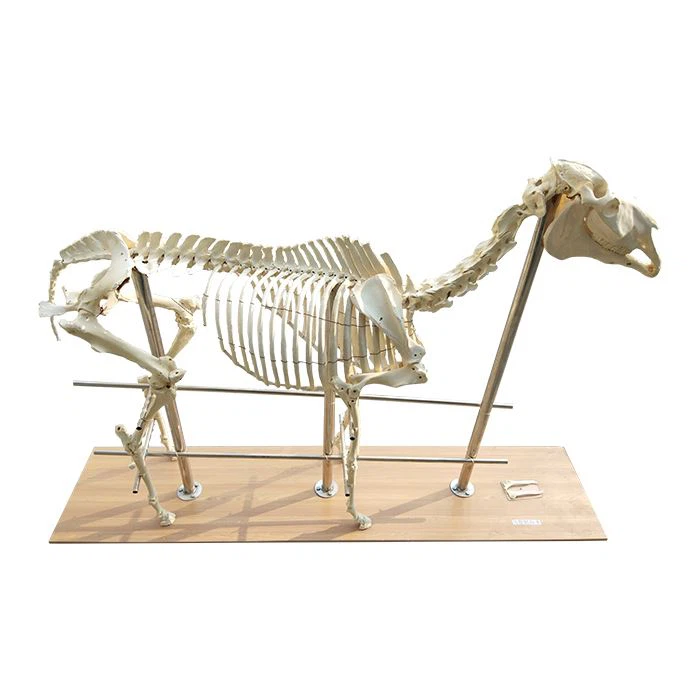
First off, let's talk about the general structure of a donkey's skeleton. The donkey has a well - built skeletal framework that's specifically designed to handle weight. Its backbone, or vertebral column, is a key player here. It's made up of a series of vertebrae that are connected in a way that provides both flexibility and strength. The vertebrae in the thoracic and lumbar regions are particularly important. They're large and sturdy, which helps distribute the weight of the load evenly across the body.
If you've ever seen a donkey carrying a heavy pack, you'll notice that it doesn't just bear the weight on one part of its back. Instead, the spine acts like a natural suspension bridge, spreading the load from the withers (the area between the shoulder blades) all the way down to the pelvis. This even distribution prevents excessive stress on any single point, reducing the risk of injury and allowing the donkey to carry heavy loads for extended periods.
The Role of the Limbs
The limbs of a donkey are another crucial aspect of its load - carrying ability. Let's start with the front legs. The shoulder joint is quite flexible, which allows the donkey to move its front legs in a wide range of motion. This flexibility is essential when walking on uneven terrain while carrying a load. The humerus bone in the upper arm is thick and strong, providing a solid base for the muscles that support the front end of the body.
When a donkey takes a step, the front legs absorb a significant amount of the impact from the ground. The radius and ulna bones in the lower front leg are also well - developed. They work together to support the weight and provide stability. The carpal bones (similar to our wrist bones) act as shock absorbers, cushioning the impact of each step.
Moving on to the hind legs, the femur bone in the upper leg is large and powerful. It's the longest and strongest bone in the donkey's body. The muscles attached to the femur are responsible for generating the forward propulsion when the donkey walks or runs. The tibia and fibula bones in the lower hind leg are also important for load - bearing. They help transfer the weight from the body to the hooves.
The hooves themselves are like natural shock - absorbing pads. They're made of a tough, keratinous material that can withstand the pressure of the load. The shape of the hooves is also designed to provide a large surface area in contact with the ground, which helps distribute the weight evenly and prevents the donkey from sinking into soft ground.

Comparison with Other Animals
It's interesting to compare the donkey's skeleton with those of other animals. For example, take a look at the Horse Skeleton. Horses are also known for their load - carrying abilities, but there are some differences. Horses are generally larger and more powerful than donkeys, and their skeletons reflect that. Their bones are often thicker and more massive. However, donkeys are more sure - footed and better adapted to carrying loads over rough terrain.
On the other hand, if we compare a donkey's skeleton with a Dog Skeleton, the differences are even more pronounced. Dogs are much smaller and have a different skeletal structure optimized for speed and agility rather than load - carrying. Their bones are lighter and more delicate, and their joints are designed for quick, short - range movements.
The Ribcage and Internal Support
The ribcage of a donkey also plays an important role in load - carrying. It encloses and protects the vital organs such as the heart and lungs. The ribs are curved and strong, providing a rigid framework for the body. When a donkey is carrying a load, the ribcage helps maintain the overall shape and stability of the torso.
The muscles attached to the ribcage also contribute to load - support. These muscles help the donkey breathe properly while under the stress of carrying a heavy load. Adequate oxygen intake is essential for the muscles to function efficiently, especially during long - distance travel with a load.
Adaptations for Long - Distance Travel
Donkeys are well - known for their ability to carry loads over long distances. Their skeletons have several adaptations that support this. The bones are dense and strong, which helps them withstand the wear and tear of long - term use. The joints are also designed to be durable. They have a thick layer of cartilage that reduces friction between the bones, allowing for smooth movement.
The donkey's skeleton also has a relatively low center of gravity. This makes it more stable when walking on uneven ground or when carrying a load that might otherwise cause it to lose balance. A low center of gravity means that the donkey is less likely to tip over, even when navigating through difficult terrain.
How Our Animal Skeletons Can Help You
As an Animal Skeleton supplier, we offer high - quality donkey skeletons that are perfect for educational purposes, research, or even as unique decorative pieces. Our skeletons are carefully prepared to ensure that all the bones are intact and properly articulated.
Whether you're a teacher looking to educate your students about animal anatomy, a researcher studying the biomechanics of load - carrying animals, or someone with a passion for unique home decor, our donkey skeletons are a great choice. We take pride in providing skeletons that are not only accurate but also ethically sourced.
If you're interested in learning more about our products or have any questions, we'd love to hear from you. Just reach out to us, and we'll be happy to assist you in your procurement process. We can provide detailed information about the skeletons, including their size, condition, and pricing.
In conclusion, the donkey's skeleton is a marvel of natural engineering. Its unique structure and adaptations allow it to carry heavy loads with remarkable efficiency and endurance. By understanding how the donkey's skeleton supports its load - carrying ability, we can gain a deeper appreciation for these amazing animals. And if you're in the market for an animal skeleton, don't hesitate to get in touch. We're here to help you find the perfect specimen for your needs.
References
- Hildebrand, M. (1988). Analysis of Vertebrate Structure. Wiley - Liss.
- Prothero, D. R., & Schoch, R. M. (2002). Horns, Tusks, and Flippers: The Evolution of Hoofed Mammals. Johns Hopkins University Press.
- Sisson, S., & Grossman, J. D. (1953). The Anatomy of the Domestic Animals. W.B. Saunders Company.


