

Hey there! As a supplier of Brain Models, I've been knee - deep in the world of neural replicas, and one question that keeps popping up is, "Are there differences between animal and human brain models?" Well, let's dive right in and find out.
First off, let's talk about the basics. Human and animal brains, while sharing some fundamental functions, have distinct features that are reflected in their models.
Structural Differences
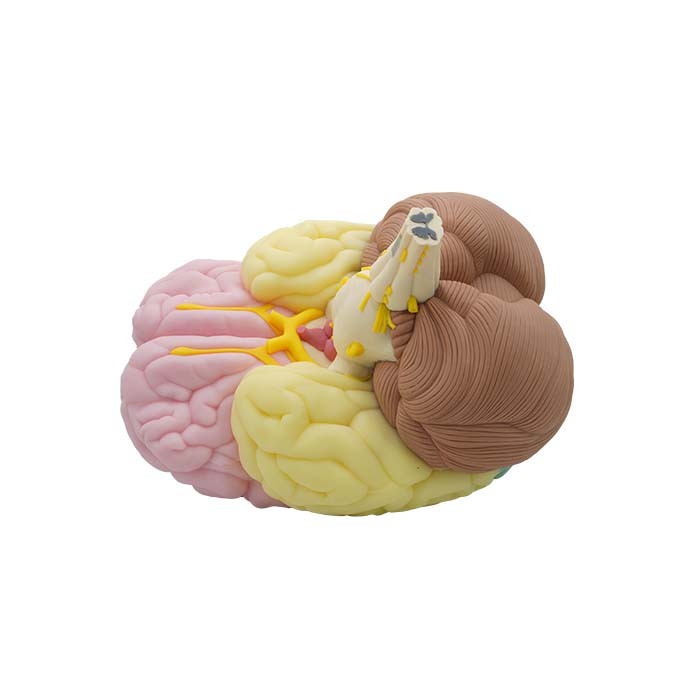
When you look at a Human Brain Model, you'll notice its highly developed cerebral cortex. This is the outer layer of the brain, and in humans, it's incredibly large and folded. These folds, called gyri and sulci, increase the surface area of the cortex, allowing for more neurons to be packed in. It's like having a bigger hard - drive in your computer. This expanded cortex is responsible for many of the things that make us uniquely human, such as complex thinking, language, and self - awareness.
In contrast, animal brains vary widely in their cortical development. For example, a mouse brain has a much smoother cortex. The lack of extensive folding means that it has a smaller surface area and fewer neurons in the cortex compared to a human brain. This is reflected in their behavior and cognitive abilities. Mice are great at basic survival tasks like finding food and avoiding predators, but they don't have the same level of complex thought as humans.
Another structural difference is the size and proportion of different brain regions. In humans, the frontal lobe, which is involved in decision - making, planning, and social behavior, is relatively large. In animals like dogs, while they do have a frontal lobe, it's not as proportionally large as in humans. This difference in size can be clearly seen when comparing a human brain model with a dog brain model.
Functional Differences
Functionally, human and animal brains also have some major disparities. Humans have a remarkable ability to communicate using complex languages. Our brains have specialized areas, like Broca's area and Wernicke's area, which are dedicated to language production and comprehension. When you think about it, it's pretty amazing that we can form sentences, tell stories, and express abstract ideas.
Animals, on the other hand, communicate in different ways. Birds use songs to attract mates and mark territory, and bees perform elaborate dances to tell other bees where to find food. While these forms of communication are sophisticated in their own right, they don't have the same level of complexity as human language.
Memory is another area where there are differences. Humans can form long - term memories of events, facts, and experiences. We can recall things that happened years ago and use that information to make decisions in the present. Some animals, like elephants, are known for their good memories, especially when it comes to remembering water sources and migration routes. But again, the nature of their memory is different from ours. They may not have the same ability to recall detailed, episodic memories like we do.
Evolutionary Reasons for the Differences
The differences between human and animal brain models can be traced back to evolution. Humans have evolved to live in complex social groups, which has driven the development of our large brains and advanced cognitive abilities. We need to be able to understand the intentions of others, cooperate on tasks, and pass on knowledge from one generation to the next.
Animals, on the other hand, have evolved to fit different ecological niches. A predator like a lion has evolved a brain that is optimized for hunting. Its senses are highly attuned to detect prey, and its motor skills are developed for quick and powerful movements. A prey animal like a rabbit has a brain that is focused on detecting danger and making rapid escapes.

Why These Differences Matter in Brain Models
As a Brain Models supplier, these differences are crucial. Educators, researchers, and medical students all rely on accurate brain models to understand the intricacies of the brain. For medical students, a Human Brain Model is essential for learning about the structure and function of the human brain, which is directly relevant to diagnosing and treating patients.
Researchers may use animal brain models to study basic neural functions. For example, fruit fly brains are often used in genetic research because they are relatively simple and easy to manipulate. By understanding how a fruit fly's brain works, researchers can gain insights into fundamental neural processes that may also apply to more complex brains, including the human brain.
Other Related Anatomy Models
In addition to brain models, we also offer other related models, such as the Vertebral Column Model and the Human Body Part Anatomy Model. The vertebral column is an important part of the nervous system as it protects the spinal cord. A good vertebral column model can help students understand how the spinal cord is housed and how it interacts with the rest of the body.
The human body part anatomy model provides a more comprehensive view of the nervous system in the context of the whole body. It shows how the brain and spinal cord are connected to different parts of the body, and how nerve impulses travel throughout the body to control movement and sensation.
Conclusion
So, to answer the question, "Are there differences between animal and human brain models?" The answer is a resounding yes. From structural and functional differences to the evolutionary reasons behind them, human and animal brains are unique in their own ways. And as a supplier of Brain Models, we take pride in providing high - quality models that accurately represent these differences.
If you're an educator looking for engaging teaching tools, a researcher in need of accurate models for your studies, or a medical student wanting to enhance your learning experience, we've got you covered. Whether it's a human brain model, an animal brain model, or other related anatomy models, we can offer the products you need. Reach out to us to start a conversation about your specific requirements. We're here to help you get the best brain models for your needs.
References
- Bear, M. F., Connors, B. W., & Paradiso, M. A. (2016). Neuroscience: Exploring the Brain. Lippincott Williams & Wilkins.
- Macphail, E. M. (1985). The Comparative Psychology of Intelligence. Harvard University Press.
- Pinker, S. (1994). The Language Instinct: How the Mind Creates Language. HarperPerennial.


